
Records That Trace Past Corinth Households
A past Corinth household leaves different kinds of dated evidence. A Corinth deed connects a party to an instrument. A directory can show a Corinth household at an address in the edition year. A permit can show municipal activity at a Corinth location, not occupancy. Microfilm, clippings, photographs, and oral histories can extend a Corinth story before the city had its own municipal record layer. People asking who lived here before should first decide whether they need a Corinth title party, a dated household lead, or a structure-history source.
| Source | Years it covers | Where held | What it can show |
|---|---|---|---|
| Recorded deeds and plats | Current Corinth online coverage varies | Denton County Official Records | Recorded parties, instrument dates, legal descriptions, plats, images when available |
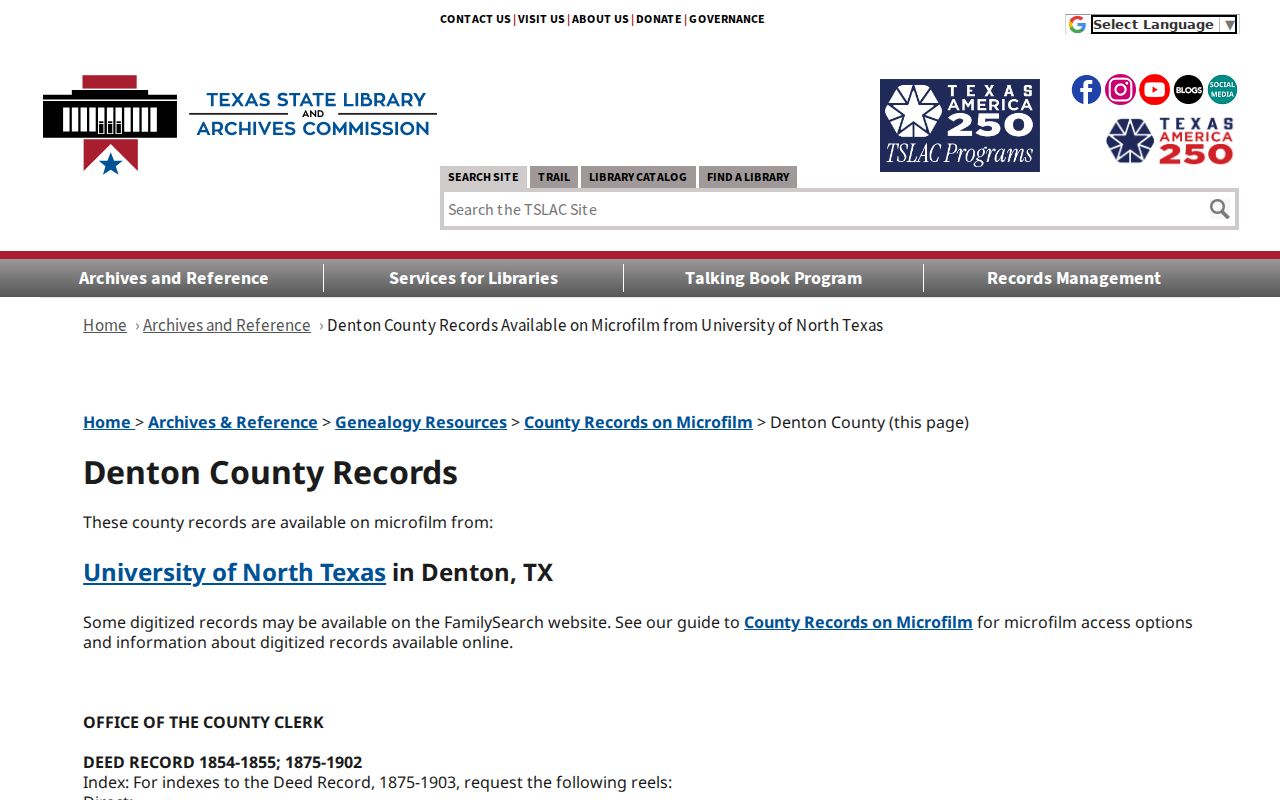
| Denton deed microfilm | 1854 to 1855 and 1875 through 1902 or 1903 in listed series | Corinth-area TSLAC Denton local records | Early deeds, direct and reverse indexes, volume and reel gaps |
| Denton directories | 1923, 1939, and listed editions from 1964 through 1993 | TSLAC and selected Corinth-area UNT pages | Dated surname, spouse, occupation, address, and notation clues |
| Structure and oral-history material | Corinth collection-specific | Denton County Office of History and Culture | Clippings, photos, interviews, structures, and local-place context |
| Corinth permit records | Older route and post-March 27, 2025 route differ | Corinth Planning and Development | Municipal project or inspection activity, not a household roster |
Denton County Official Records is the current online Corinth entry point, but its observed notice says the index was certified through September 2, 2021. Check the live portal’s dates and image availability. For a Corinth address that predates incorporation, lead with the Corinth legal description and county records rather than expecting a city file.
Anchor a Corinth Address Record to a Parcel
Past residents are easiest to trace after the modern Corinth address has been stabilized. Search Denton CAD by Corinth address, owner name, or property ID. Capture the current Corinth situs address, property ID, legal description, subdivision, addition, lot, block, and retrieval date. The legal description is usually more durable than a street label when an old record uses Denton County, a rural route, a different postal city, or an earlier road form.
CAD fields describe Corinth appraisal data. The owner or filing name is not a complete occupancy list, and a tax mailing address can be an agent, business, or out-of-area location. Corinth city GIS helps check city-line and street context. Denton County GIS and the CAD parcel layer add Corinth geometry. Use the Corinth parcel to organize the address history, then let each later source state its own role.
Note: A Corinth property record can establish a parcel connection without establishing that every named party lived at that address.
Run a Corinth Deed Chain Through Recorded Parties
After CAD supplies the Corinth legal description, use Denton County Official Records to search it with the subdivision, lot, block, grantor, grantee, party, instrument-date, and document-number fields. The portal also supports recorded date, document type, book or volume and page, remarks, and OCR image phrases. A Corinth deed-index entry without an image is a lead, not the completed title evidence. Open the recorded image when it is available and carry the prior party and legal description into the next Corinth search.
The Denton County Official Records search below shows the Corinth portal route for a historical instrument trail.
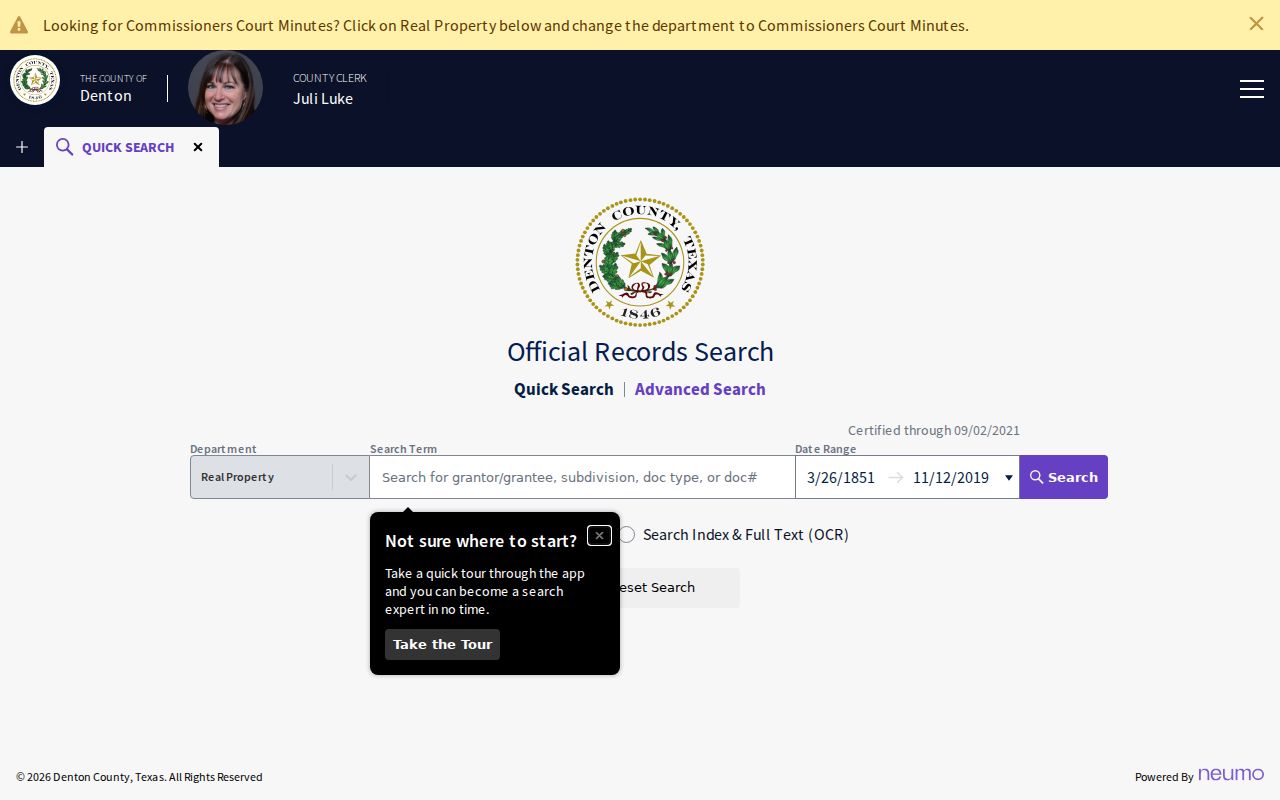
Use the Corinth instrument date and recorded date as different facts. A later recording can refer to an earlier transfer, easement, release, trust, lien, or court judgment. The party named in such a record may have a legal role without being a past Corinth household member.
- Open the Corinth parcel in CAD and record the property ID and full legal description.
- Search the current Corinth recorded party and the legal description in Denton County Official Records.
- Open the Corinth purchase instrument and identify the prior grantor, grantee, document date, and legal-description wording.
- Search the prior party as grantee to locate the earlier Corinth acquisition, while keeping the parcel description in view.
- Continue backward until the Corinth online chain reaches a gap, then use the listed microfilm and archive routes.
- Grantor and grantee
- The grantor transfers a Corinth interest named in an instrument. The grantee receives that interest. Neither term alone means resident.
- Chain of title
- A dated Corinth sequence of instruments that traces interests in the same parcel or legal description.
- Legal description
- The recorded Corinth land description, often using subdivision, lot, block, or survey terms. It can bridge an old record when the street address cannot.
Check Corinth Plats Before Assuming a Street Name
Plats have their own department in the Denton County official-records portal. A plat can connect a street, easement, subdivision, lot, and block before an address becomes stable in later records. Search the legal description and subdivision variations as well as the street. For early Corinth-area research, the county legal description may remain a better search key than the city or postal label.
A modern Corinth street and an old Corinth parcel are not automatically the same thing. Later plats can split one tract into several parcels, and a directory may place a household near a street without proving title. Record whether the Corinth link is title continuity, subdivision history, or only neighborhood context. If a source does not bridge the two address forms, leave the relationship unresolved.
Corinth Households Before City Records
Corinth incorporated on September 19, 1960. The city history reports about 400 residents at incorporation, with early council meetings held in residents’ homes. That date is a practical search switch. Before incorporation, look first to Denton County deed, probate, marriage, court, directory, newspaper, and poll-tax collections. After incorporation, add Corinth municipal court, permits, City Secretary material, city maps, and public-information requests where the record type fits.
This Corinth division does not mean the earlier people were absent from the Corinth area. It reflects where their Corinth records are most likely held. A historic item may say Denton, Denton County, rural route, or another local label. Preserve the label as printed and then record the modern Corinth parcel or municipal context separately.
Denton Directories Add Corinth Household Leads
TSLAC’s dated list identifies Denton directory volumes for 1923, 1939, 1964, 1969, 1973, 1975, 1977 through 1983, 1985 through 1988 or 1989, and 1990 through 1993. Corinth is not separately listed. Use the Corinth edition’s city scope as part of the evidence and inspect the book instead of promising a Corinth entry for every year. TSLAC copies are non-circulating in the Austin Reading Room and cannot be searched or scanned by phone or email. Corinth reference help is available at ref@tsl.texas.gov and 512-463-5455.
The TSLAC Denton local-records page is the county archive route for those older materials and microfilm.
UNT’s digitized 1923 and 1939 Denton pages show what a household lead can contain: surname, spouse notation, occupation, residence address, phone or business information, and special marks. In the 1939 book, h marks home and r marks room or residence notation. Such entries are dated snapshots, not a current Corinth resident finding. The collection details are available through the Corinth city directory route.
Match Corinth Past Households to Their Dates
Dated Corinth household links become more credible when two sources point to the same structure without blurring their roles. Use a simple flow: current parcel and legal description, recorded instrument, dated directory or archive item, then any eligible historical schedule or newspaper lead. Keep the edition date, source title, page or reel, street form, and name exactly as found. A matching surname by itself is weak evidence.
Directory evidence is stronger when the surname or household marker, the address or parcel bridge, and the year or adjacent-year continuity line up. A spouse change, occupation change, telephone exchange, or altered street label may be a useful lead, but it should be recorded as uncertainty until another source confirms the connection. The Denton County structure-history guidance recommends joining address, owner, legal description, addition, lot, block, GIS, clippings, photos, and directories rather than relying on one name.
Corinth Archive Records Need Their Gaps
TSLAC’s Denton inventory reaches well before municipal Corinth. It lists deed records from 1854 to 1855, deed volumes and direct or reverse indexes from 1875 into 1902 or 1903, marriage volumes from 1875 to 1905, probate appraisals and inventories from 1876 to 1889, probate minutes through 1931, wills from 1876 to 1893, and district civil minutes from 1877 into the twentieth century. These series can provide a land or family trail when a modern portal ends.
The archive also documents limitations, including a missing deed volume 61 and some unfilmed or limited court material. A jump in the trail is not evidence that no transaction occurred. Mark the exact volume or reel gap, then test adjacent deeds, plats, probate, newspapers, photographs, or later instruments. The Denton County Office of History and Culture also offers oral-history searching by Interviewee Name, OH Number, or Keyword. Transcript PDFs can be requested for research, and physical copies are available in the Research Room.
Corinth’s Taylor Log Cabin Is a Place Trail
The Taylor Log Cabin offers a distinct Corinth address-history example. Denton County says the cabin originated in Corinth in the 1860s, remained with descendants until 1992, and was later moved and restored at the Historical Park. Its path shows why a Corinth structure can be documented through county historical material, family memory, photographs, and a current public-park account even when there is no citywide nineteenth-century resident directory.
For a Corinth house-history question, a structure-first search can be more productive than a broad surname search. Try the Corinth legal description, street, subdivision, institution, or structure name in county oral-history and clipping collections. Then connect the result back to the parcel only when the source supports the relationship.
Limits on Corinth House-History Records
A deed names a party to an instrument, not every person who lived at the property. A permit identifies a project, applicant, or contractor. A directory can miss people outside its coverage and is only a snapshot for its edition date. Tax mailing addresses, court service addresses, and postal labels have their own roles. Describe each record as it is and retain gaps where the evidence stops.
Lawful use. Corinth house-history research is for family history, estate questions, and personal curiosity. Do not use old records to track, harass, intimidate, or harm a living person.
Texas Public Information Act requests can reach city-held records through the City Secretary, but access is still subject to exceptions and redactions. For a correction, contact Denton CAD for appraisal fields, the County Clerk for recorded instruments, the City Secretary for city records, or the archive holding the historical material.