
Corinth City Directory Collections
There is no separately listed Corinth city-directory series in the TSLAC directory list. The practical collection is therefore a Denton-area and Denton County shelf, checked against the book’s actual coverage. TSLAC lists Denton editions for 1923, 1939, 1964, 1969, 1973, 1975, 1977 through 1983, 1985 through 1988 or 1989, and 1990 through 1993. Corinth incorporated in 1960, so earlier local people and place research often belongs in county or regional sources.
| Corinth collection | Corinth years | Corinth holding place | Corinth access |
|---|---|---|---|
| Corinth research in TSLAC Denton city-directory holdings | 1923, 1939, 1964, 1969, 1973, 1975, 1977-1983, 1985-1988/89, 1990-1993 | Texas State Library and Archives Commission Reading Room | Non-circulating Corinth research, print, and microform collection |
| Corinth-area Retail Merchants’ Association Denton directory | 1923 | UNT Portal, credited to Denton Public Library | Digitized Corinth research page image and OCR |
| Corinth-area Denton directory sample | 1939 | UNT Portal, credited to Denton Public Library | Digitized Corinth research page image and OCR |
| Standalone Corinth series | Not located in official Corinth sources | Not listed by TSLAC for Corinth | Use Corinth county, Denton-area, and local-history routes instead |
These dates are holdings, not a promise that every page is online or that each volume covers all of Corinth. For an unlisted year, ask the library or archive about an uncatalogued copy, microfilm reel, or partner collection and record the response as a gap.
Corinth’s Denton Directory Starting Point
Corinth’s municipal history explains the collection route. The city incorporated on September 19, 1960. Before that, area research can require Denton County deeds, probate, marriage, court, poll-tax, newspaper, and directory sources, sometimes under Denton or a rural-place reference. After incorporation, city administrative, permit, court, and map records become additional layers. The date is a jurisdiction switch, not a reason to rewrite an older book’s place label.
For a historical household, first pin down the address form that appears in the directory. Then use CAD, GIS, and the County Clerk index to test whether a modern parcel or legal description can bridge that label. A current street name may not have existed when the book was printed. If the bridge is uncertain, retain the historical address as written instead of assigning it to a modern location without a plat, deed, map, or archive note.
The Denton County Office of History and Culture adds clippings, photographs, oral histories, courthouse material, and local publications to this route. Its oral-history collection can be searched by Interviewee Name, OH Number, and Keyword, making a street, church, school, business, park, or structure a useful research term when a surname is uncertain.
Note: Corinth incorporation changes the custodian route, but it does not justify changing an earlier Denton or county label.
Reading a Corinth Historical Directory Entry
A directory entry is a dated editorial record, not a present-day profile. The UNT samples show why it pays to read each part of the line. A surname and given name identify how the editor indexed the person. A spouse name can supply a family clue. An address identifies a location as printed. An occupation or employer describes a point in time. A telephone or business listing can lead to another dated source. Every field should be transcribed with the volume year and page.
| Corinth name | The surname and given name as the directory indexed them for Corinth research. |
|---|---|
| Corinth spouse or household clue | Often shown in parentheses; it is a dated Corinth identification aid. |
| Corinth address | The street form used by that edition, which may differ from a modern Corinth label. |
| Corinth occupation or employer | A historical entry field, useful only in the edition’s Corinth date context. |
| Corinth phone or business line | A directory lead that may point to a separate Corinth listing or local collection. |
- Corinth criss-cross directory
- The section arranged by address or street, useful when a Corinth name is uncertain.
- Corinth householder index
- An arrangement focused on Corinth heads of households, not every person at an address.
- Corinth abbreviation key
- The volume’s guide to symbols and shortened terms; photograph or transcribe it before interpreting a Corinth entry.
Corinth Historical Directory Marks in 1923 and 1939
The digitized 1923 Denton directory displays surname entries, spouse names in parentheses, occupations, residence addresses, telephone and business material, and an asterisk used for children under 18. These are meaningful transcription details. They do not turn the book into a census or a Corinth-only listing. Keep the mark with the page image and avoid expanding a symbol into a broader conclusion than the volume supports.
The UNT 1923 Denton directory page offers a direct view of the older entry style.
The page illustrates why spouse names, occupation, address, phone, business detail, and child symbols belong in a dated entry inventory rather than a modern resident record.
The 1939 Denton directory uses h for home and r for room or residence, and it can show spouse, widow notation, employer, street address, telephone, and business information. A room notation is especially important because it tells the reader how the publisher described that address relationship.
The UNT 1939 Denton directory page preserves the later notation in an image and OCR record.
Read the abbreviation key and the full page before comparing the 1939 notation with another directory year.
Corinth Historical Directory Access and Digitized Pages
TSLAC’s city-directory collection is in the Austin Reading Room. The print and microform volumes are non-circulating, and the library does not search or scan directories by phone or email. The reference contact listed by TSLAC is ref@tsl.texas.gov and 512-463-5455. That access rule makes a volume citation important: a researcher needs the city, year, and page before an in-person visit can be efficient.
The TSLAC city-directory Reading Room information below shows the institutional access route for the collection.
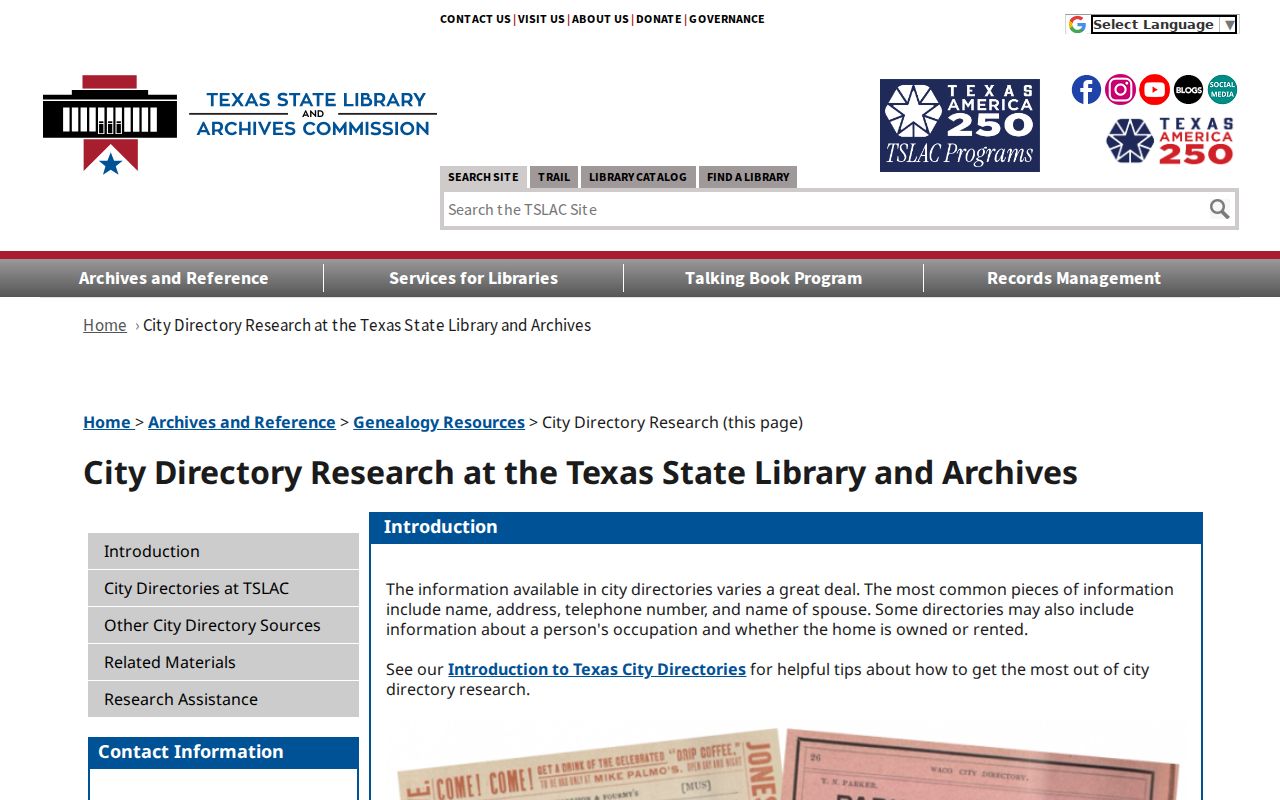
For the digitized examples, UNT provides page images and OCR. The county Research Room and local library connection add a different kind of access: collections or services may require a visit, a transcript request, a card, or a staff-assisted search rather than a public web query.
Corinth residents can use Denton Public Library branches and genealogy services under the terms stated on the city library page. The listed card terms and proof requirements are access rules, not evidence about a reader or a household.
Note: Corinth historical collections may require an in-person visit or request even when a related UNT example is digitized.
Tracing Corinth Historical Directories Across Years
Follow a historical household through dates, not through assumptions. Begin with the first edition that has the right surname or address form. Copy the full entry, including symbols. Compare the next available edition, then pair the interval with an appropriate deed, plat, newspaper, photograph, probate item, or census record. The important question is whether the sources support the same person, parcel, or household role at the same time.
- Find the earliest Corinth matching entry and record its edition city, year, page, exact spelling, address, and notation.
- Check the next listed directory year for a Corinth address change, spouse clue, or changed home and room notation.
- Use a Corinth CAD property ID and legal description to test the address against a current parcel without overwriting the old address form.
- Inspect a recorded Corinth deed or plat for the land relationship, then add a census, obituary, newspaper, or oral-history source only when it addresses the same date or fact.
- End the Corinth chain with a clear gap statement when the household disappears, the street cannot be bridged, or the collection lacks an edition.
A disappearance may reflect a move, death, a change in publication coverage, a changed spelling, or an unlisted relationship. It is not a finding by itself. The best note gives the last documented edition, the next edition checked, and the next custodian or collection to consult.
Note: A Corinth directory gap should be recorded with the editions searched and the next archive or county source.
Corinth’s Pre-1960 Historical Switch
Historical record keeping in Corinth has three useful periods. Before 1960, county-only land and family records usually dominate. After incorporation, city and county records accumulate side by side. The recent period splits information across current and legacy portals. New permits and plans moved to Civic Access on March 27, 2025, while older permit material follows the city or eTRAKiT route. A history search should record that system boundary as part of the evidence.
| Corinth period | Likely Corinth record route | Corinth search caution |
|---|---|---|
| Before September 19, 1960 | Corinth-area Denton County deeds, probate, court, newspapers, and Denton-area directories | Keep Corinth rural, Denton, and county labels as printed |
| After incorporation | Corinth county sources plus city administrative, permit, court, and map records | Choose the correct Corinth city or county custodian |
| Current portal period | Corinth CAD, GIS, Official Records, current city systems, and legacy eTRAKiT | Preserve Corinth portal date and coverage boundaries |
TSLAC’s microfilm notes also describe gaps in some Corinth county series, including a missing deed volume. A Corinth gap is a research limit, not evidence that a transaction or household did not exist.
Taylor Cabin, a Corinth Directory Story
The Taylor Log Cabin supplies an unusually specific Corinth history lead. Denton County says it originated in Corinth in the 1860s, remained with descendants until 1992, and was moved and restored at the county Historical Park. Its evidence trail is place-based: county history, restoration material, photographs, oral histories, deeds, and local collections can be more useful than a surname-only search for an early structure.
Corinth’s original City Hall is another dated Corinth civic marker. The official Corinth history says early council meetings were held in residents’ homes; the former City Hall at 2003 Corinth Street opened in 1976 and was demolished on September 19, 2019. A directory entry near a Corinth civic address is still a dated listing, but a city-history source can supply the separate municipal context.
Note: Place history can lead to records, but it does not identify a household unless a dated record names that relationship.
Limits of a Corinth Historical Directory Entry
A Corinth historical directory entry is a snapshot limited by its publisher, edition date, place coverage, and indexing choices. It may omit people, use an older street label, show a business or room relationship, or place an address under Denton. It cannot establish current residence, ownership, or a complete household. The right next step depends on the fact being tested: a deed image for an instrument, CAD for a parcel, a city request for a municipal file, or an archive for a historical lead.
When the goal changes from a historical household to a current address record, use the Corinth street directory route for CAD, GIS, deeds, and city systems. Keep the historical volume citation beside the modern record rather than merging their dates.